Walking-stick
The walking-stick is a modest but telling object in Franz Kafka's novel The Castle, appearing at two crucial junctures in K.'s story. It first surfaces during his arrival at the village, where it is noted as part of his meager possessions, and later becomes the focus of a promise he makes to the young Hans Brunswick. Though seemingly incidental, the stick carries symbolic weight, echoing K.'s role as a land surveyor and his precarious position in the village's rigid social order.
Identity and Introduction
When K. first arrives at the Bridge Inn, exhausted and seeking lodging, the young man Schwarzer describes him to the castle authorities over the telephone as a man of "very ragged appearance in his thirties, sleeping peacefully on a straw mattress, with a tiny rucksack as a pillow and a gnarled walking-stick within reach." This description, delivered with a mixture of suspicion and derision, establishes the walking-stick as one of K.'s few possessions, alongside his rucksack. The stick is "gnarled," suggesting both age and ruggedness, and it is placed "within reach," implying that K. keeps it close even in sleep, as a tool or a defense. This initial mention frames the stick as an emblem of K.'s itinerant, land-surveying profession—a practical instrument for navigating unfamiliar terrain—and his outsider status in the village, where he is immediately challenged for lacking a permit to stay.
The Promise to Hans
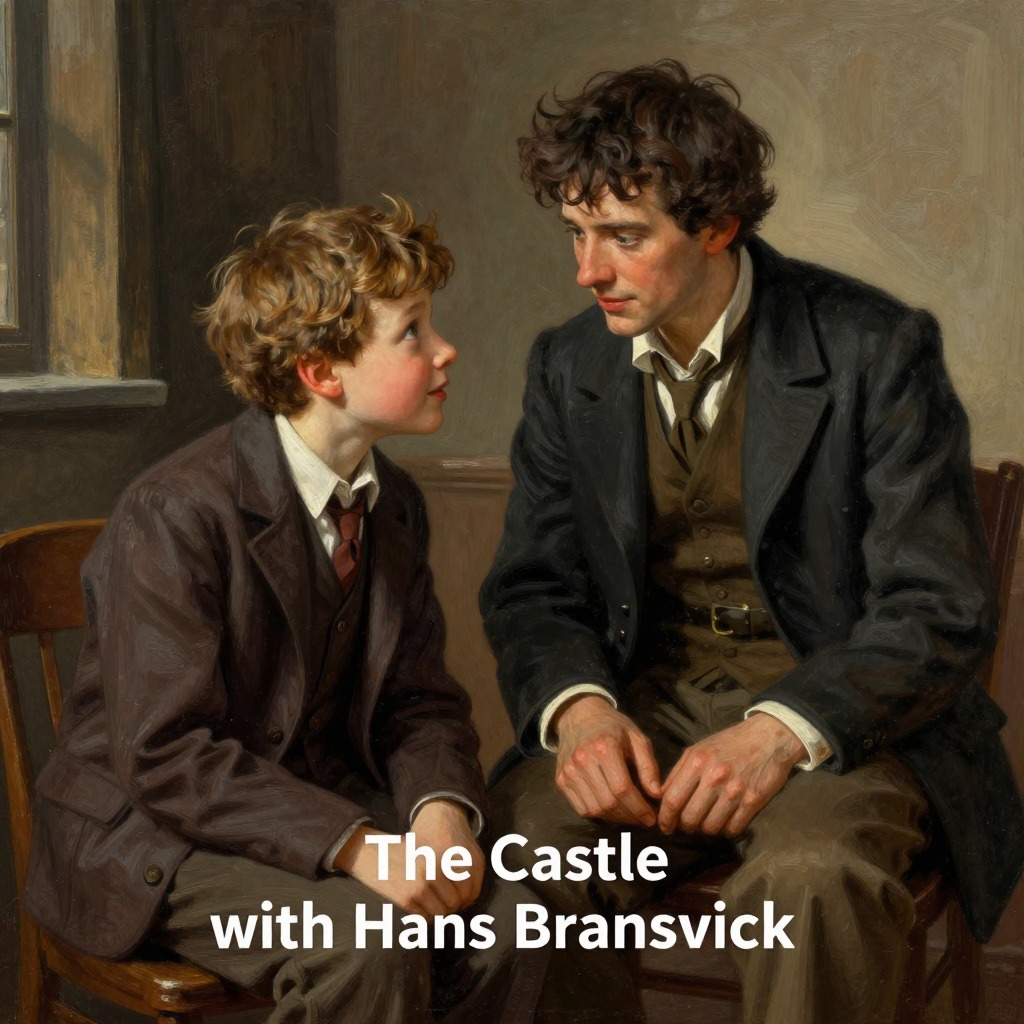
Later, during a conversation with Hans Brunswick, the young son of the shoemaker Otto Brunswick, the walking-stick reappears as a token of K.'s goodwill. Hans, who has come to offer help to K. and Frieda, is described as playing "absent-mindedly" with K.'s "handsome gnarled walking-stick" that lies on the table. K., noticing the boy's interest, promises to make him an even better one if their plans succeed. This promise is significant: it is a gesture of friendship and a rare moment of warmth in K.'s otherwise fraught interactions with the villagers. The stick, which K. values enough to carry with him, becomes a symbol of the potential bond between K. and Hans, and by extension, a link to Hans's mother, whom K. hopes to meet. The promise also reflects K.'s own craft—he claims to know how to make such sticks—aligning with his identity as a surveyor who works with tools and measurements.
Thematic Significance
The walking-stick functions as a subtle motif that underscores K.'s alienation and his attempts to establish connections in a world that resists him. In the first instance, it is part of the inventory that marks him as a vagrant in the eyes of the castle authorities, contributing to the suspicion that surrounds him. In the second, it becomes a means of reaching out to Hans, a child who represents a possible ally in K.'s struggle to navigate the village's bureaucratic maze. The stick's "gnarled" quality suggests the hardships K. has endured, while its presence in both scenes highlights the contrast between his initial helplessness and his later, albeit tentative, efforts to forge relationships. Ultimately, the walking-stick is a small but resonant object, embodying K.'s dual role as a stranger and a craftsman, and his persistent, often futile, attempts to find a foothold in the castle's domain.